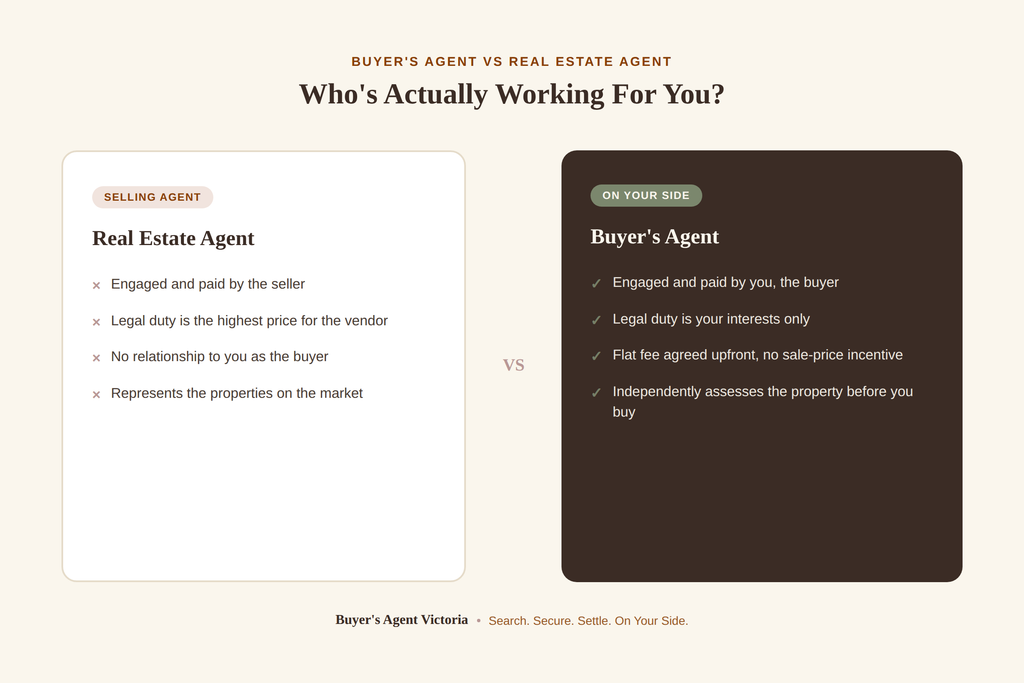
Category: Buyer’s Agent Education

Guides explaining how buyer’s agents work, what to expect from the process, and the questions worth asking before you engage one.

  • How to Choose a Buyer’s Advocate in Melbourne: 7 Checks Before You Sign

    How to Choose a Buyer’s Advocate in Melbourne: 7 Checks Before You Sign

    Search “buyers advocate Melbourne” and you’ll find page after page of firms making similar promises: off-market access, sharper negotiation, less stress. The way to choose between them is to check what sits underneath those promises, from the licence and the fee to the person who actually turns up to the inspection.

    Below are the 7 checks I’d run on any buyer’s advocate in Melbourne, including me, before you sign their agreement.
    How to choose a buyers advocate in Melbourne: 7 checks before you sign an agreement

    Key points

    • A buyer’s advocate in Victoria must be a licensed estate agent. Check the Consumer Affairs Victoria public register.
    • An agent can’t act for you and the seller on the same property. Ask whether the firm also sells homes.
    • Fees aren’t set by law. Get the fee, the GST and any rebates they receive in writing.
    • Read the buyers’ agency authority for the term, the fee if no property is found, and how to end it.
    • Ask who does your inspections and negotiation, and how well they know your suburbs.

    Buying in Melbourne’s North in the next few months? I have 3 Foundation Client places at half my standard fee. Answer 7 questions to see if you fit.

    Buyers Advocate Melbourne: What Do They Actually Do?

    Consumer Affairs Victoria describes a buyer’s agent as a licensed estate agent who, for a fee, acts for a buyer instead of a seller. In practice that covers some or all of the search: setting the brief, finding and inspecting properties, checking the contract and section 32 with your conveyancer, and negotiating or bidding at auction for you.

    Buyer’s advocate and buyer’s agent mean the same thing in Victoria. Some firms do the full search and others offer auction bidding or negotiation only, so know which service you’re comparing.

    How Do You Choose a Buyer’s Advocate in Melbourne? 7 Checks

    1. Check their licence on the public register

    Every buyer’s advocate in Victoria must hold an estate agent’s licence, or work as an agent’s representative under a licensed agent. Search their name and their company on the CAV public register. It shows when the licence was granted, any conditions on it, and any tribunal or court orders that affect it.

    2. Make sure they only act for buyers

    An estate agent can’t act for a buyer and a seller on the same transaction. Some firms still list and sell homes on other days, and they may be friendly with the agent selling the house you want. Ask directly whether the business represents buyers only.

    3. Get the full fee, and any rebates, in writing

    Fees in Victoria aren’t set by law. Most Melbourne buyer’s advocates charge a fixed fee or a percentage of the purchase price, usually plus GST. Ask for the total including GST, when each part is payable, and whether they receive rebates, commissions or referral fees from anyone they send you to, such as brokers or conveyancers. My guide to buyer’s agent costs in Melbourne explains the common fee models.

    4. Find out who actually does the work

    At some firms, the person who signs you up isn’t the person who inspects homes or negotiates. Ask who will walk through properties with you, who will speak to selling agents, and who bids on auction day. Then ask how many other clients that person is working with.

    5. Test their local knowledge

    Ask what recent sales they’d compare your target home with, and which streets they’d avoid and why. In Northcote and Thornbury that should include where the heritage overlays sit and which streets near the Merri and Darebin creeks carry flood-related planning controls. A vague answer is a sign they’ll be learning your market on your money.

    6. Read the buyers’ agency authority before you sign

    The authority is the contract that lets the advocate act for you. Check how long it runs, what services it covers, what you pay if they don’t find a property you like, and how either side can end it. Be wary of an authority with no end date, or one where ending it early still costs you most of the fee.

    7. Ask how they handle two clients chasing the same home

    Larger firms often have several buyers with similar briefs. CAV suggests asking what their policy is when more than one client wants the same property. You want a clear answer before it happens.

    Foundation Clients Offer: 3 places remaining

    I buy across Melbourne, with a focus on the North and a specialty in Northcote, Thornbury and Preston. Foundation Clients get the full property search, brief to settlement, for $8,250 instead of $16,500. In return I ask for a case study and a written testimonial after settlement.

    Answer 7 Questions to See If You Fit

    Search. Secure. Settle. On Your Side.

    Are Buyer’s Advocates in Melbourne Worth the Fee?

    It depends on what you’d do without one. If you have time to inspect every weekend, know the local sales and are comfortable negotiating, you may not need one. If you’ve been missing out at auction, or you’re buying in a suburb you don’t know, the fee is easier to justify. I cover this in more detail in is a buyer’s agent worth it.

    Ask any advocate for named, recent results that you can check. Two of mine: Mel H. searched on her own for 5 months and was outbid at auction before we secured a home in Mount Clear, near Ballarat, off-market at the first inspection, $40,000 under comparable sales. Lucinda searched for 6 months, then secured a home in Fairfield by private sale, about $10,000 under recent sales in her block.

    What I’d Want You to Check About Me

    I’m a licensed buyer’s advocate (licence 091847L), and Buyer’s Agent Victoria holds licence 091857L. I act for buyers only and never list or sell property. My fee is a flat $16,500 including GST for a full search to settlement. I was born in Thornbury and I do every inspection, every agent conversation and every bid myself. You’ll find more answers in my 7 questions to ask a buyer’s agent.

    Frequently Asked Questions

    How do I choose a buyers advocate in Melbourne?

    Check their estate agent licence on the Consumer Affairs Victoria public register, confirm they act for buyers only, get the full fee and any rebates in writing, find out who does the work, test their local knowledge and read the buyers’ agency authority before you sign.

    Do buyer’s advocates need a licence in Victoria?

    Yes. A buyer’s advocate in Victoria must be a licensed estate agent or an agent’s representative working for one. You can check a licence on the Consumer Affairs Victoria public register.

    How much does a buyer’s advocate cost in Melbourne?

    Fees aren’t set by law. Most charge a fixed fee or a percentage of the purchase price, usually plus GST. Get the total including GST in writing, and ask what you pay if no property is found.

    Can a buyer’s advocate also work for the seller?

    Not on the same property. An estate agent can’t act for the buyer and the seller in the same transaction. Ask whether the firm also lists and sells homes.

    What is a buyers’ agency authority?

    It’s the agreement that gives a buyer’s advocate authority to act for you. It should set out the term, the services, the fees and how either side can end it.


    The right buyer’s advocate is licensed, works only for you, tells you the full fee up front and knows your suburbs. Run the 7 checks before you sign, whoever you’re talking to.

    Foundation Clients Offer: 3 places remaining

    I buy across Melbourne, with a focus on the North and a specialty in Northcote, Thornbury and Preston. Foundation Clients get the full property search, brief to settlement, for $8,250 instead of $16,500. In return I ask for a case study and a written testimonial after settlement.

    Answer 7 Questions to See If You Fit

    Search. Secure. Settle. On Your Side.

    Jason McCall is a licensed buyer’s advocate (licence 091847L) and the founder of Buyer’s Agent Victoria Pty Ltd (licence 091857L), based in Thornbury. He is a member of the REIV and PICA.
  • Cooling Off Period in Victoria: How It Works and When You Get None

    Cooling Off Period in Victoria: How It Works and When You Get None

    The cooling off period in Victoria gives you 3 clear business days after you sign a private sale contract to change your mind and walk away. It isn’t free. You lose $100 or 0.2% of the price, whichever is more, and it doesn’t apply at all if you buy at auction or close to one.

    Below I cover how long the cooling off period is, what it costs, how to use it, the 5 situations where you don’t get one, and why I’d rather you never need it.

    Cooling off period in Victoria: 3 business days, and when you get none

    Key points

    • You have 3 clear business days from the day you sign, not the day the seller signs.
    • Weekends and public holidays don’t count, so Melbourne Cup Day can push your deadline out.
    • Cooling off costs the greater of $100 or 0.2% of the price. On an $800,000 home that’s $1,600.
    • You cool off by giving written notice to the seller or the seller’s agent. You don’t need a reason.
    • There’s no cooling off at auction, within 3 clear business days before or after an advertised auction, or when you buy through a company.

    Buying in Melbourne’s North in the next few months? I have 3 Foundation Client places at half my standard fee. Answer 7 questions to see if you fit.

    How Long Is the Cooling Off Period in Victoria?

    It’s 3 clear business days, under section 31 of the Sale of Land Act 1962. Consumer Affairs Victoria says the period starts from the date you sign the contract, not the date the seller signs it. It covers residential property, and rural property under 20 hectares, bought by private sale.

    “Clear” means the day you sign doesn’t count. Saturdays, Sundays and public holidays don’t count either. Melbourne Cup Day, Tuesday 3 November 2026, is a public holiday in metropolitan Melbourne, so a contract signed on Monday 2 November gives you Wednesday, Thursday and Friday. Ask your conveyancer to confirm the exact deadline the day you sign.

    How Much Does It Cost to Cool Off?

    If you cool off, the seller can keep $100 or 0.2% of the purchase price, whichever is greater. Everything else you’ve paid comes back to you. At Inner North prices, 0.2% is always the bigger number:

    • $600,000 apartment: $1,200
    • $800,000 townhouse: $1,600
    • $1,200,000 house: $2,400

    That’s a real cost, though it’s small next to buying the wrong property. It also doesn’t cover any money you’ve spent on inspections or legal fees before you pulled out.

    How Do You Cool Off on a Property in Victoria?

    You give written notice to the seller or the seller’s agent before the period ends. You don’t have to give a reason. Email works, but get confirmation that it was received, and keep a copy.

    Tell your conveyancer before you send anything. They can word the notice, check the deadline and deal with the refund of your deposit, less the amount the seller is allowed to keep.

    When Doesn’t the Cooling Off Period Apply? 5 Exceptions

    Consumer Affairs Victoria lists the situations where you have no right to cool off. These are the ones that catch buyers out:

    1. You buy at auction, or close to one

    There’s no cooling off when you buy at a public auction. It also doesn’t apply if you sign within 3 clear business days before or after a publicly advertised auction. That includes buying the property before auction day, or negotiating with the agent after it’s passed in. See CAV’s guide to buying at auction.

    2. The property is mainly commercial or industrial

    Shops, offices and warehouses used mainly for commercial or industrial purposes don’t carry a cooling off period.

    3. It’s a farm over 20 hectares

    Farming land over 20 hectares, used mainly for farming, is excluded.

    4. You signed a contract for the same property before

    If you previously signed a contract for the same property on substantially the same terms, you don’t get a second cooling off period.

    5. You’re an estate agent or you buy through a company

    Cooling off doesn’t apply when the buyer is an estate agent or a corporate body. If you’re buying through a company, including a self-managed super fund with a corporate trustee, plan on having no cooling off period at all.

    One rule you may still see in older guides: getting legal advice before you sign no longer takes away your right to cool off. That exception was removed in 2012.

    Foundation Clients Offer: 3 places remaining

    I buy across Melbourne, with a focus on the North and a specialty in Northcote, Thornbury and Preston. Foundation Clients get the full property search, brief to settlement, for $8,250 instead of $16,500. In return I ask for a case study and a written testimonial after settlement.

    Answer 7 Questions to See If You Fit

    Search. Secure. Settle. On Your Side.

    Is a Cooling Off Period the Same as a Finance or Building Clause?

    No. Cooling off is a right the law gives you on most private sales, and it ends after 3 clear business days whatever happens. A finance clause or a building inspection clause is a special condition you negotiate into the contract, with its own deadline and its own terms.

    If your loan approval or building report won’t be ready within 3 business days, cooling off won’t protect you. Ask for the condition in the contract before you sign, and have your conveyancer check the wording.

    What I Tell Buyers Before They Sign a Private Sale

    Treat cooling off as a safety net, and do your checks before you sign. On a $1.2 million Preston house, changing your mind costs $2,400, and at auction you can’t change your mind at all.

    Before my clients sign, their conveyancer has read the section 32 and the contract, they have pre-approval from their lender, and the building inspection is done or written into the contract. If you’re buying your first home, my first home buyer guide covers the schemes and the steps to take before you inspect.

    Frequently Asked Questions

    How long is the cooling off period in Victoria?

    3 clear business days from the day you sign the contract. The day you sign, weekends and public holidays don’t count.

    How much do you lose if you cool off in Victoria?

    The seller can keep $100 or 0.2% of the purchase price, whichever is greater. On an $800,000 property that’s $1,600. The rest of what you’ve paid is refunded.

    Is there a cooling off period at auction in Victoria?

    No. There’s no cooling off if you buy at a public auction, or if you sign within 3 clear business days before or after a publicly advertised auction.

    How do I cool off on a property contract?

    Give written notice to the seller or the seller’s agent before the 3 clear business days end. You don’t need to give a reason. Speak to your conveyancer first and keep proof the notice was received.

    Does the cooling off period apply if I buy through a company?

    No. Cooling off doesn’t apply when the buyer is a corporate body or an estate agent, so a purchase through a company, including an SMSF with a corporate trustee, has no cooling off period.


    The cooling off period in Victoria is short and it costs money to use. Know your deadline the day you sign, and do the checks that matter before you sign rather than after.

    Foundation Clients Offer: 3 places remaining

    I buy across Melbourne, with a focus on the North and a specialty in Northcote, Thornbury and Preston. Foundation Clients get the full property search, brief to settlement, for $8,250 instead of $16,500. In return I ask for a case study and a written testimonial after settlement.

    Answer 7 Questions to See If You Fit

    Search. Secure. Settle. On Your Side.

    Jason McCall is a licensed buyer’s advocate (licence 091847L) and the founder of Buyer’s Agent Victoria Pty Ltd (licence 091857L), based in Thornbury. He is a member of the REIV and PICA.
  • First Home Buyer in Victoria: Grants, Stamp Duty and What to Do First

    First Home Buyer in Victoria: Grants, Stamp Duty and What to Do First

    As a first home buyer in Victoria you can get real help: no stamp duty on a home up to $600,000, a $10,000 grant if you buy or build a new home, and a federal scheme that lets you buy with a 5% deposit. Knowing which of these you qualify for, before you start inspecting, changes what you can afford and where you should look.

    Below I cover each one, what the numbers mean for buyers in Melbourne’s North, five steps to take first, and the mistakes I see first home buyers make.

    Key points

    • First home buyers in Victoria pay no stamp duty on a home valued at $600,000 or less, and reduced duty between $600,001 and $750,000.
    • The $10,000 First Home Owner Grant is for new homes valued up to $750,000. Established homes don’t qualify.
    • Under the federal 5% Deposit Scheme, the price cap in Melbourne is $950,000, and there has been no income cap since 1 October 2025.
    • Get pre-approval and confirm your eligibility before you inspect, so you know your real budget.

    Buying in Melbourne’s North in the next few months? I have 3 Foundation Client places at half my standard fee. Answer 7 questions to see if you fit.

    First home buyer in Victoria guide to grants, stamp duty and first steps

    What Help Can a First Home Buyer in Victoria Get?

    There are three main kinds of help, and they work differently. Two come from the Victorian Government through the State Revenue Office. The third is a federal scheme run through Housing Australia and participating lenders.

    Stamp duty exemption and concession

    If you’re a first home buyer in Victoria and the home is worth $600,000 or less, you pay no land transfer (stamp) duty. Between $600,001 and $750,000 you pay a reduced amount, and above $750,000 you pay full duty. This applies to established homes as well as new ones, as long as you meet the State Revenue Office’s conditions, including living in the home as your principal place of residence.

    The $10,000 First Home Owner Grant

    The First Home Owner Grant is $10,000 for a new home valued up to $750,000. That includes building a new home, buying off the plan, or buying a home that hasn’t been lived in before. You need to live in it as your principal place of residence for at least 12 months. Buying an established house or apartment doesn’t qualify.

    The 5% Deposit Scheme

    Under the federal scheme, the government guarantees part of your loan, so you can buy with a 5% deposit without paying lenders mortgage insurance. Since 1 October 2025 there has been no income cap and no limit on places, according to Housing Australia. The property price cap is $950,000 in Melbourne and Geelong, and $650,000 in the rest of Victoria. You apply through a participating lender or broker.

    What Does That Mean in Melbourne’s North?

    It depends on what you’re buying. Hotspotting’s Suburb Report for Northcote (16 October 2026) puts the median house price at $1,653,000, well above every cap. The median unit price is $617,500, which sits just above the $600,000 full stamp duty exemption and well under the $950,000 cap for the 5% Deposit Scheme.

    For many first home buyers in the inner north, that means a unit or apartment is where the schemes do the most work. If you’re set on a house, the deposit scheme can still help with the deposit, but you’ll be paying full stamp duty, so plan for it.

    First Home Buyer in Victoria: 5 Steps Before You Start Looking

    1. Get pre-approval, and ask which schemes you qualify for

    A broker can tell you what you can borrow, whether you’re eligible for the 5% Deposit Scheme, and which lenders offer it. Check when your pre-approval expires, because they don’t last forever.

    2. Work out your total costs, not just the deposit

    Add stamp duty if it applies, conveyancing, a building and pest inspection, loan fees, insurance and moving costs. Your budget is the price you can pay after all of those, with a buffer left over.

    3. Write a one-page brief

    List your must-haves and your nice-to-haves. Most buyers have to give ground on one of four things: price, location, the dwelling or the land. Decide which one before you inspect, and decisions on the day get much easier.

    4. Learn the documents

    Ask for the Property Price Statement at every inspection, and read my guide to the section 32 so you know what to look for in the vendor statement. Have a conveyancer lined up before you find the place, so the contract can be checked quickly.

    5. Know the difference between auction and private sale

    There’s no cooling-off period when you buy at auction in Victoria. For most private sales you have 3 business days to cool off, but you lose $100 or 0.2% of the price, whichever is more. If you’re bidding, your finance and contract review need to be done before auction day.

    Foundation Clients Offer: 3 places remaining

    I buy across Melbourne, with a focus on the North and a specialty in Northcote, Thornbury and Preston. Foundation Clients get the full property search, brief to settlement, for $8,250 instead of $16,500. In return I ask for a case study and a written testimonial after settlement.

    Answer 7 Questions to See If You Fit

    Search. Secure. Settle. On Your Side.

    What Mistakes Do First Home Buyers Make?

    • Assuming the $10,000 grant applies to an established home. It doesn’t.
    • Budgeting right up to a scheme cap, with nothing left for duty, fees or a rate rise.
    • Bidding at auction before the contract and section 32 have been read.
    • Letting pre-approval expire in the middle of the search.
    • Skipping the building and pest inspection to save a few hundred dollars.

    Should a First Home Buyer Use a Buyer’s Agent?

    Not every first home buyer needs one. If you have time to inspect every weekend, you’re comfortable negotiating with a selling agent and you know the area, you can do it yourself with a good broker and conveyancer.

    A buyer’s agent is worth it when you’re short on time, you keep missing out, or you’re buying somewhere you don’t know well. I act only for buyers, and I handle the search, the inspections, the negotiation and the run to settlement. My guide to off-market properties and my pre-settlement inspection checklist cover two stages first home buyers often ask me about.

    Frequently Asked Questions

    Do first home buyers pay stamp duty in Victoria?

    Not on a home valued at $600,000 or less, if you meet the State Revenue Office conditions. Between $600,001 and $750,000 you pay reduced duty, and above $750,000 you pay full duty.

    How much is the First Home Owner Grant in Victoria?

    It is $10,000 for a new home valued up to $750,000, and you need to live in it for at least 12 months. Established homes don’t qualify.

    What is the price cap for the 5% Deposit Scheme in Melbourne?

    The cap is $950,000 in Melbourne and Geelong, and $650,000 in the rest of Victoria. There has been no income cap since 1 October 2025.

    Can a first home buyer in Victoria use the stamp duty exemption and the 5% Deposit Scheme together?

    Yes, if you meet the conditions for each. The duty exemption comes from the State Revenue Office and the deposit scheme from Housing Australia through your lender, so check eligibility for both with your broker.

    What should a first home buyer in Victoria do first?

    Get pre-approval and confirm which schemes you qualify for, work out your total costs, write a one-page brief, and have a conveyancer ready before you start inspecting.


    Being a first home buyer in Victoria comes with real help, but only if you check your eligibility early and budget for everything the schemes don’t cover. Get pre-approval, write your brief, and have the documents checked before you sign or bid.

    Foundation Clients Offer: 3 places remaining

    I buy across Melbourne, with a focus on the North and a specialty in Northcote, Thornbury and Preston. Foundation Clients get the full property search, brief to settlement, for $8,250 instead of $16,500. In return I ask for a case study and a written testimonial after settlement.

    Answer 7 Questions to See If You Fit

    Search. Secure. Settle. On Your Side.

    Jason McCall is a licensed buyer’s advocate (licence 091847L) and the founder of Buyer’s Agent Victoria Pty Ltd (licence 091857L), based in Thornbury. He is a member of the REIV and PICA. This article is general information, not financial advice. Check your eligibility with the State Revenue Office and your broker.
  • Section 32 in Victoria: What to Check Before You Sign

    Section 32 in Victoria: What to Check Before You Sign

    A section 32 is the legal statement a seller in Victoria must give you before you sign a contract to buy their property. It’s where title problems, easements, planning controls and unapproved building work usually show up first, so reading it properly is one of the cheapest ways to avoid an expensive mistake.

    Below I cover what a section 32 contains, 7 red flags to look for, when you get it (and what changes in 2027), what happens if it’s wrong, and who should read it before you sign.

    Section 32 in Victoria: what to check before you sign

    Key points

    • The section 32, or vendor statement, is required under section 32 of the Sale of Land Act 1962.
    • The seller must provide it before you sign. Ask for it as soon as you’re serious about a property.
    • Check the title, easements, planning zone and overlays, building permits and outgoings against what you saw at the inspection.
    • From 1 June 2027, agents must make the section 32 available at least 14 days before an auction or fixed-date sale.
    • Have a conveyancer or property lawyer read it with the contract before you sign or bid.

    Buying in Melbourne’s North in the next few months? I have 3 Foundation Client places at half my standard fee. Answer 7 questions to see if you fit.

    What Is a Section 32 Statement?

    It’s the vendor statement set out in section 32 of Victoria’s Sale of Land Act 1962. The seller, usually through their conveyancer, prepares it, and the agent gives it to buyers along with the contract of sale.

    It tells you the legal facts about the property that you can’t see at an open home: who owns it, what’s registered on the title, how the land can be used and what it costs to hold. It doesn’t tell you about the condition of the building. That’s the job of a building and pest inspection.

    What’s in a Section 32 in Victoria?

    The exact contents depend on the property, but a section 32 usually covers:

    • Title details, including the registered owner and any mortgage, caveat or other charge
    • Easements, covenants and other restrictions on the title, with a copy of the title plan
    • Planning information, including the zone and any overlays that apply
    • Building permits issued in the past 7 years, and owner-builder insurance or an inspection report where relevant
    • Outgoings such as council rates, water rates and land tax
    • Notices or orders from councils and authorities, such as road widening or fencing notices
    • The services connected to the property, and those that aren’t
    • For units and apartments, an owners corporation certificate showing fees, special levies and planned works

    RACV’s guide gives a plain-English overview of these sections if you want a second explanation.

    Section 32 Red Flags: 7 Things to Check Before You Sign

    1. The seller isn’t the registered owner

    The name on the title should match the seller. If it doesn’t, for example in a deceased estate or a mortgagee sale, the section 32 should show the seller’s authority to sell. Check any mortgage or caveat listed, and ask your conveyancer how it will be cleared at settlement.

    2. Easements where you’d want to build

    Look at the title plan. A drainage or sewerage easement across the back yard can stop an extension, a pool or a garage in that spot. A shared driveway easement means someone else has a right to use part of the land.

    3. Covenants on the title

    Some titles carry covenants that limit what you can build, such as a single dwelling or certain building materials. If you’re buying with a plan to develop or subdivide, a covenant can end that plan before it starts.

    4. Zoning and overlays

    The planning section shows the zone and any overlays. Heritage overlays are common in parts of Northcote and Thornbury, and they can mean you need a permit to demolish, extend or change the front of a house. Check the overlays against what you want to do with the property in five years, as well as today.

    5. Building work with no permit listed

    Compare the building permits section with what you saw at the inspection. A new deck, an extension or a converted garage with no permit in the past 7 years is worth asking about before you sign. Unapproved work can cost you to fix and can cause problems when you sell.

    6. Owner-builder work

    If the seller built or renovated the home as an owner-builder in recent years, the section 32 should include domestic building insurance details and a recent inspection report. Read that report closely, as it lists the defects the inspector found.

    7. Outgoings, notices and owners corporation levies

    Check the rates and other outgoings so you know the holding costs. Look for any outstanding notices or orders. For a unit or apartment, read the owners corporation certificate for special levies, planned works and any legal disputes, because those costs can land on the next owner.

    Foundation Clients Offer: 3 places remaining

    I buy across Melbourne, with a focus on the North and a specialty in Northcote, Thornbury and Preston. Foundation Clients get the full property search, brief to settlement, for $8,250 instead of $16,500. In return I ask for a case study and a written testimonial after settlement.

    Answer 7 Questions to See If You Fit

    Search. Secure. Settle. On Your Side.

    When Do You Get the Section 32?

    Under the current law, the seller must give you the section 32 before you sign the contract. Most agents attach it to the contract or send it on request. Ask for it as soon as you’re seriously considering a property, so your conveyancer has time to read it before an auction or before you make an offer.

    That changes from 1 June 2027. Consumer Affairs Victoria says agents will have to make the section 32 available within 14 days after a property is advertised for private sale, and at least 14 days before an auction or fixed-date sale. If a property isn’t advertised, it must be available before you sign.

    What Happens If the Section 32 Is Wrong or Missing?

    If the seller doesn’t comply with section 32, for example by leaving out required information, the buyer can generally end the contract at any time before settlement. There’s an exception: a court can refuse if it’s satisfied the seller acted honestly and reasonably, ought fairly to be excused, and you are in substantially as good a position as if they had complied.

    Don’t try to work this out on your own. If something looks wrong or missing, raise it with your conveyancer before you sign, or as soon as you notice it after.

    Who Should Read the Section 32 Before You Sign?

    A conveyancer or property lawyer should read the section 32 and the contract together, before you sign or bid. They’ll pick up legal problems with the title, the special conditions and anything missing.

    Your building inspector covers the physical condition, which the section 32 doesn’t. If you’re buying with finance, check that the contract gives you enough time for your lender too.

    Timing matters most at auction. There’s no cooling-off period when you buy at auction in Victoria, so the section 32 needs to be read before auction day. For most private sales you have 3 business days to cool off after signing, but you lose $100 or 0.2% of the price, whichever is more.

    What I Look For First in a Section 32

    When a client is serious about a property, the first things I check are the title plan for easements, the planning overlays and the building permits list, alongside my own inspection notes. If the permits don’t match the extension I walked through, or an overlay rules out the renovation they have in mind, we know before anyone signs. The full legal review is then done by their conveyancer.

    Still searching? My guide to off-market properties in Melbourne covers the checks to run before you offer, and my pre-settlement inspection guide covers your last look before you pay.

    Frequently Asked Questions

    What is a section 32 in Victoria?

    A section 32 is the vendor statement required under section 32 of the Sale of Land Act 1962. It sets out the title, planning, easements, outgoings, building permits and other legal details of the property, and the seller must provide it before you sign the contract.

    Do I have to get my section 32 checked?

    It isn’t compulsory, but it’s the main legal document you rely on when you buy. Have a conveyancer or property lawyer read it, together with the contract, before you sign or bid.

    What are the red flags in a section 32?

    Common ones are a seller who isn’t the registered owner, easements where you’d want to build, a heritage or other overlay you didn’t expect, building work with no permit listed, owner-builder work, outstanding notices and, for units, special levies or pending owners corporation works.

    Can I pull out if the section 32 is wrong?

    If the seller hasn’t complied with section 32, the buyer can generally end the contract at any time before settlement. A court can refuse that if the seller acted honestly and reasonably and you are no worse off. Speak to your conveyancer before you act.

    Is there a cooling-off period after I sign in Victoria?

    For most private sales you have 3 business days to cool off, and you lose $100 or 0.2% of the price, whichever is more. There’s no cooling-off period if you buy at auction, or within 3 business days before or after an advertised auction.


    A section 32 takes an hour or two to read properly, and it’s the document you rely on when you buy. Ask for it early, check it against the property you inspected, and have your conveyancer read it before you sign or bid.

    Foundation Clients Offer: 3 places remaining

    I buy across Melbourne, with a focus on the North and a specialty in Northcote, Thornbury and Preston. Foundation Clients get the full property search, brief to settlement, for $8,250 instead of $16,500. In return I ask for a case study and a written testimonial after settlement.

    Answer 7 Questions to See If You Fit

    Search. Secure. Settle. On Your Side.

    Jason McCall is a licensed buyer’s advocate (licence 091847L) and the founder of Buyer’s Agent Victoria Pty Ltd (licence 091857L), based in Thornbury. He is a member of the REIV and PICA.
  • Pre-Settlement Inspection in Victoria: What to Check Before You Pay

    Pre-Settlement Inspection in Victoria: What to Check Before You Pay

    A pre settlement inspection is your last look at a property before you hand over the balance of the price. It’s the point where you confirm the home is in the condition you bought it in, with everything the contract says comes with it.

    In Victoria it’s a right under the standard contract, and plenty of buyers still treat it as a quick walk-through. Below I cover when to book it, what to check, what to do if something is wrong, and what I found at a client’s inspection in Fairfield this month.

    Pre settlement inspection guide for Victorian buyers

    Key points

    • Victoria’s standard contract lets you inspect at any reasonable time in the 7 days before settlement, including settlement day.
    • The seller must hand over the property in the same condition as on the day of sale, apart from fair wear and tear.
    • Book the pre settlement inspection a few days out, so there’s time to fix a problem before settlement.
    • If something is wrong, take photos and call your conveyancer before settlement goes ahead.

    Buying in Melbourne’s North in the next few months? I have 3 Foundation Client places at half my standard fee. Answer 7 questions to see if you fit.

    What Is a Pre-Settlement Inspection?

    It’s a final inspection of the property you’ve bought, done in the days before settlement. Consumer Affairs Victoria says you’re entitled to inspect at any reasonable time during the week before settlement, and that you arrange it through the agent.

    The general conditions in Victoria’s standard contract of sale set out two rules that make the inspection worth doing. The seller carries the risk of loss or damage until settlement, and must deliver the property in the same condition it was in on the day of sale, except for fair wear and tear. Contract editions vary, so check the version you signed with your conveyancer.

    A pre settlement inspection isn’t a building inspection. It won’t tell you about the structure or the roof. Its job is to compare the property today with the property you agreed to buy.

    When Should You Book a Pre Settlement Inspection?

    Book it with the selling agent as soon as the settlement date is confirmed. Two or three days before settlement works well. If you find a problem, that leaves time for the seller to fix it and for your conveyancer to act.

    Leaving it to the morning of settlement squeezes everyone. If the seller is still moving out, ask for a time after they’ve gone, since that’s when damage from the move shows up.

    Pre Settlement Inspection: 7 Things Buyers Miss

    1. Inclusions listed in the contract

    Have the contract with you. Light fittings, window furnishings, the dishwasher, a garden shed: if it’s listed, check it’s still there and that nothing has been swapped for a cheaper version.

    2. Appliances and services

    Turn things on. Run the oven, heating, cooling, hot water and taps, and flush the toilets. A fault that existed on the day of sale is a different conversation to one that appeared since.

    3. Damage from moving out

    Removalists bump walls, scratch floors and chip door frames. Look closely at hallways, stairs and doorways, the places furniture goes through.

    4. Agreed repairs

    If the contract or a special condition says the seller will fix something before settlement, check it’s done, and done properly.

    5. Items that should be gone

    Unless you agreed otherwise, the seller’s belongings and rubbish should be removed. Check the garage, the shed and behind the house.

    6. Signs of water

    Look under sinks and around the hot water service, and at ceilings for fresh stains. Water damage that wasn’t there at the sale is exactly what this inspection is for.

    7. Keys, remotes and codes

    Ask what keys, garage remotes, alarm codes and letterbox keys will be handed over, and confirm it in writing with the agent.

    Foundation Clients Offer: 3 places remaining

    I buy across Melbourne, with a focus on the North and a specialty in Northcote, Thornbury and Preston. Foundation Clients get the full property search, brief to settlement, for $8,250 instead of $16,500. In return I ask for a case study and a written testimonial after settlement.

    Answer 7 Questions to See If You Fit

    Search. Secure. Settle. On Your Side.

    What If Something Is Wrong at the Inspection?

    Stay calm and document it. Take dated photos and video, note what’s missing or damaged, and call your conveyancer the same day.

    Consumer Affairs Victoria says you can request a repair if something isn’t in the condition it was in on the day of sale. Depending on the problem and your contract, your conveyancer may negotiate a repair before settlement, a reduction or an amount held back. Get advice before you refuse to settle, because failing to settle on time can put you in default.

    Don’t let the agent talk you into accepting a promise that a problem will be sorted later. Once settlement goes through, your bargaining position changes.

    What I Found at a Recent Pre-Settlement Inspection

    My client Lucinda bought a two-bedroom apartment in Fairfield by private sale, and we did her pre settlement inspection together the Wednesday before settlement. The sellers had moved everything out and nothing was left behind, apart from a TV wall mount, which she was happy to keep.

    We went through every cupboard, ran the split system and checked the fittings worked. Then we went back over two items from the building and pest report. A small section of timber in the corner of the second bedroom had perished, and she’ll have it assessed further when the new carpet goes in. In the bathroom, a cap hadn’t been fitted off properly, so that’s being looked at before the washing machine goes in.

    Both items were already in the building and pest report, so neither was new damage since the sale. Checking them again meant she settled knowing exactly what to sort out first. We also talked through adding a split system to the bedrooms later, run through a false bulkhead. Everything in the contract was accounted for, and settlement went through on Monday 12 October.

    Do You Have to Attend It Yourself?

    No. You can send someone in your place, and some buyers ask their conveyancer or buyer’s agent to attend. As part of my service I attend my clients’ pre settlement inspections myself, which helps when you’re at work, interstate or buying an investment property.

    If you’re buying with a lender, Consumer Affairs Victoria also notes your lender will usually recommend building insurance from the date the contract is signed, not from settlement. Organise it early.

    Still at the search stage? My guide to off-market properties in Melbourne covers the checks to run before you sign, and 7 Questions to Ask a Buyer’s Agent covers what to ask before you engage help.

    Frequently Asked Questions

    When can I do a pre settlement inspection in Victoria?

    Under Victoria’s standard contract of sale you can inspect at any reasonable time in the 7 days before settlement, including settlement day. Book it through the selling agent.

    Is a pre settlement inspection compulsory?

    No, but skipping it means you settle without confirming the property is in the condition you bought it in. Once settlement happens it is harder to fix a problem.

    What should I check at a pre settlement inspection?

    Check the inclusions listed in the contract are there and working, look for damage from the move, confirm agreed repairs are done, check the seller’s belongings are removed and confirm what keys and remotes will be handed over.

    What happens if something is damaged before settlement?

    The seller carries the risk until settlement and must hand the property over in the same condition as on the day of sale, apart from fair wear and tear. Take photos and call your conveyancer straight away so they can request a repair or negotiate before settlement.

    Can my buyer’s agent do the pre settlement inspection for me?

    Yes. You can send someone in your place, such as your buyer’s agent or conveyancer. I attend my clients’ pre settlement inspections myself.


    A pre settlement inspection takes less than an hour and it’s your last chance to fix a problem while the money is still yours. Book it early, take the contract with you, and call your conveyancer before settlement if anything is wrong.

    Foundation Clients Offer: 3 places remaining

    I buy across Melbourne, with a focus on the North and a specialty in Northcote, Thornbury and Preston. Foundation Clients get the full property search, brief to settlement, for $8,250 instead of $16,500. In return I ask for a case study and a written testimonial after settlement.

    Answer 7 Questions to See If You Fit

    Search. Secure. Settle. On Your Side.

    Jason McCall is a licensed buyer’s advocate (licence 091847L) and the founder of Buyer’s Agent Victoria Pty Ltd (licence 091857L), based in Thornbury. He is a member of the REIV and PICA.
  • Off-Market Properties in Melbourne: How to Find Them and What to Check

    Off-Market Properties in Melbourne: How to Find Them and What to Check

    If you’ve searched off market properties Melbourne, you’ve seen plenty of promises about exclusive access. Off-market sales are real and they do suit some buyers. They also carry risks that an advertised campaign would normally bring to the surface for you.

    Below I cover how an off-market sale works in Victoria, whether you pay less, how buyers find these properties and five mistakes to avoid. I’ve also included the new price rules that started on 1 October 2026, because they change what you can ask an agent for.

    Off market properties Melbourne buyers guide

    Key points

    • An off-market property is sold without a public advertising campaign, so most buyers never see it.
    • Off-market doesn’t mean under value. Some vendors use it to test a price at the top of the range.
    • Since 1 October 2026, an agent selling off-market must still prepare a Property Price Statement and give you a copy at an inspection or on request.
    • Most off market properties Melbourne buyers hear about come through local selling agents, so your relationships with them matter.
    • Off-market deals often move in days, so your finance, conveyancer and building inspector need to be ready before you find one.

    Buying in Melbourne’s North in the next few months? I have 3 Foundation Client places at half my standard fee. Answer 7 questions to see if you fit.

    What Is an Off-Market Property?

    An off-market property is one the selling agent offers to a small group of buyers without listing it on realestate.com.au or Domain. You’ll also hear the terms pre-market, silent listing and quiet sale. They all describe a property being sold before, or instead of, a public campaign.

    An off-market sale isn’t the same thing as a private sale. In Victoria, a private sale is any sale by negotiation rather than auction, and most private sales are advertised. An off-market sale is usually a private sale that was never advertised.

    Why Do Vendors Sell Off Market?

    Common reasons include privacy, avoiding the cost of a marketing campaign, a tight timeframe, or a tenancy that makes open inspections awkward. Some vendors want to see what a buyer will pay before committing to a full campaign.

    That last reason matters to you. A vendor testing the market quietly has nothing to lose by asking a high price, because if nobody bites they can still go to auction.

    Are Off-Market Properties Cheaper?

    Sometimes, and only when the buyer knows what the property is worth. Fewer buyers in the room can mean less competition. It also means no auction result or campaign feedback to tell you whether the price is fair.

    One of my clients, Mel H., had spent five months searching on her own in Mount Clear, near Ballarat, and kept getting outbid at auction. We secured an off-market property on the first inspection, $40,000 under what comparable sales said it was worth. You can read more about her purchase in Is a Buyer’s Agent Worth It in Melbourne’s Inner North?

    That result came from knowing the comparable sales before the conversation started. The reverse happens too, and an off-market price can sit above what the same property would fetch with a full campaign.

    Foundation Clients Offer: 3 places remaining

    I buy across Melbourne, with a focus on the North and a specialty in Northcote, Thornbury and Preston. Foundation Clients get the full property search, brief to settlement, for $8,250 instead of $16,500. In return I ask for a case study and a written testimonial after settlement.

    Answer 7 Questions to See If You Fit

    Search. Secure. Settle. On Your Side.

    How Do You Find Off Market Properties in Melbourne?

    There’s no secret list. Most off market properties Melbourne buyers hear about come through relationships with the selling agents who work a particular area. These four steps help:

    1. Get on local agents’ buyer lists. Give each agent a clear brief: suburbs, budget, property type and how soon you can buy. A vague brief gets forgotten.
    2. Follow up regularly. Agents call the buyers they’ve spoken to recently and who sound ready.
    3. Have your finance approved first. An agent with a quiet listing wants a buyer who can sign this week.
    4. Use a buyer’s agent who deals with those agents every week. In Thornbury, Northcote and Preston, keeping in touch with the local selling agents is a regular part of my searches.

    I can’t promise an off-market property on every search, and I’d be wary of anyone who does. That promise is one of the red flags in 7 Questions to Ask a Buyer’s Agent.

    What Changed for Off-Market Sales on 1 October 2026?

    Victoria introduced new price transparency rules on 1 October 2026. The Property Price Statement replaced the Statement of Information, according to Consumer Affairs Victoria. Three parts of the change matter if you’re looking at off market properties Melbourne agents are selling quietly:

    • The agent must still prepare a Property Price Statement for an off-market property and provide copies at inspections or on request.
    • The agent must publish the sold price within 7 days of the sale becoming unconditional, even if the property was never advertised.
    • The new rule requiring the reserve price to be published 7 days before an auction or fixed-date sale does not apply to off-market sales.

    These points come from Consumer Affairs Victoria’s industry Q&As on the new laws. As sold prices for unadvertised sales are published, off-market results should become easier to find when you research comparable sales.

    Off Market Properties Melbourne: 5 Mistakes Buyers Make

    1. Assuming off-market means a bargain

    The vendor chose this method for their own reasons. Work out the value from comparable sales before you talk price, and don’t let the word exclusive do the negotiating for the agent.

    2. Not asking for the Property Price Statement

    Ask for it at the first inspection. It sets out the agent’s price indication and the comparable sales they relied on. If the agent can’t produce one, treat that as a warning sign.

    3. Signing before the section 32 has been reviewed

    The vendor must give you the vendor statement, known as the section 32, before you sign the contract. Have a conveyancer or property lawyer read it first, even if the agent says another buyer is about to sign.

    4. Skipping the building and pest inspection

    Time pressure is a common reason buyers skip it. An off-market property hasn’t been through the scrutiny of a public campaign, so an independent inspection matters more. I inspect every shortlisted property myself before a client sees it, using the eye I built over years assessing insurance claims, and I still recommend a professional building and pest report.

    5. Turning up without finance in place

    An off-market opportunity often goes to the first ready buyer. If your pre-approval has lapsed or your broker hasn’t seen your latest payslips, you’ll lose it to someone who is ready.

    If you’re weighing up whether the cost of help makes sense, I’ve compared buyer’s agent fee models in dollars in How Much Does a Buyer’s Agent Cost in Melbourne?

    Frequently Asked Questions

    What is an off market property?

    An off market property is a home sold without a public advertising campaign. The selling agent offers it to a small group of buyers on their list instead of listing it on the major property websites.

    Are off market properties cheaper in Melbourne?

    Not automatically. Less competition can help a well prepared buyer, but some vendors sell off market to test a high price. Check comparable sales before you make an offer.

    How do I find off market properties in Melbourne?

    Get on the buyer lists of the selling agents in your target suburbs, give them a clear brief, follow up regularly and have your finance approved. A buyer’s agent who works those suburbs every week will also hear about them.

    Does an off market sale need a Property Price Statement?

    Yes. Since 1 October 2026, an agent selling off market in Victoria must prepare a Property Price Statement and provide copies at inspections or on request. The sold price must also be published within 7 days of the sale becoming unconditional.

    Is there a cooling off period on an off market purchase in Victoria?

    Usually yes. A residential private sale has a cooling off period of three clear business days from when you sign. If you withdraw you lose 100 dollars or 0.2 percent of the price, whichever is greater. It does not apply at a public auction or within three clear business days either side of one.


    Off market properties Melbourne agents hold back can be a good buy for a prepared buyer. Know the value, ask for the Property Price Statement, read the section 32 and have your finance ready. The cooling-off rules for private sales are set out on Consumer Affairs Victoria’s private sale page.

    Foundation Clients Offer: 3 places remaining

    I buy across Melbourne, with a focus on the North and a specialty in Northcote, Thornbury and Preston. Foundation Clients get the full property search, brief to settlement, for $8,250 instead of $16,500. In return I ask for a case study and a written testimonial after settlement.

    Answer 7 Questions to See If You Fit

    Search. Secure. Settle. On Your Side.

    Jason McCall is a licensed buyer’s advocate (licence 091847L) and the founder of Buyer’s Agent Victoria Pty Ltd (licence 091857L), based in Thornbury. He is a member of the REIV and PICA.
  • 7 Questions to Ask a Buyer’s Agent, and What to Tell Them in Return

    7 Questions to Ask a Buyer’s Agent, and What to Tell Them in Return

    Some lists of questions to ask a buyers agent run to fifteen or more. You need seven, covering who the agent works for, how they’re paid, who does the work and how they’re regulated.

    I’ve answered each one myself below, so you can see what a straight answer looks like. I’ve also added the part these lists tend to leave out: what your agent needs you to be upfront about in return. In my experience, the things a buyer doesn’t say are what cause trouble later.

    Questions to ask a buyers agent before you sign

    Key points

    • The seven questions to ask a buyers agent cover payment, licence, fees, inspections, workload, sourcing and identity checks.
    • In Victoria, a buyer’s agent works under an estate agent’s licence, and you can check it yourself on Consumer Affairs Victoria’s public register.
    • Ask for the total fee including GST, in writing, before you sign anything.
    • Honesty has to run both ways. A half answer about your budget, your finance or who else is deciding can undo the search later.

    Buying in Melbourne’s North in the next few months? I have 3 Foundation Client places at half my standard fee. Answer 7 questions to see if you fit.

    The 7 Questions to Ask a Buyers Agent

    1. Who pays you, and do you take money from anyone else?

    A buyer’s agent should be paid by you and nobody else. An agent who also collects a commission or referral fee from a selling agent or a developer has a reason to steer you toward particular properties.

    Red flag: a vague answer, or “it depends on the property”.

    My answer: I act only for buyers, and I never take a fee from a selling agent. If the two roles are blurry, read Buyer’s Agent vs Real Estate Agent: What’s the Actual Difference?

    In return: tell your agent if you’re already speaking with another buyer’s agent, or if you’ve made an offer through a selling agent on a property you still want.

    2. Are you licensed, and can I check it?

    In Victoria, buyer’s agents work under an estate agent’s licence issued by Consumer Affairs Victoria. You can search an agent’s name on the public register of licensed estate agents in a couple of minutes.

    Red flag: reluctance to give you a licence number.

    My answer: my licence is 091847L and the company licence is 091857L. I’m a member of the REIV and PICA.

    In return: expect to be checked too. That is question 7.

    3. What is the total fee including GST, and when is it due?

    Fees come as a percentage of the purchase price, a tiered fixed fee or a flat fee, and the model changes what you end up paying. I’ve compared all three in dollars in How Much Does a Buyer’s Agent Cost in Melbourne?

    Red flag: a quote that leaves out GST, or a fee nobody can put a number on until you’ve bought.

    My answer: a flat $16,500 including GST, paid in four instalments of $4,125.

    In return: give your real budget ceiling, including what you’d stretch to, and say plainly where your finance stands. “Pre-approved” and “talking to a broker” lead to very different searches.

    4. Who inspects the properties, and is it in person?

    Listing photos are staged to sell. Part of what you’re paying for is someone standing in the property and reading its condition. Ask whether the person you’re speaking to does the inspections or hands them to someone else.

    Red flag: a shortlist built from listings and video walk-throughs alone.

    My answer: I inspect every shortlisted property myself, in person, before it reaches you.

    In return: tell your agent what you’ve already seen and ruled out, and why. If there’s a property you’ve already fallen for, say so.

    Foundation Clients Offer: 3 places remaining

    I buy across Melbourne, with a focus on the North and a specialty in Northcote, Thornbury and Preston. Foundation Clients get the full property search, brief to settlement, for $8,250 instead of $16,500. In return I ask for a case study and a written testimonial after settlement.

    Answer 7 Questions to See If You Fit

    Search. Secure. Settle. On Your Side.

    5. How many clients are you working with right now?

    A proper search takes hours every week. An agent carrying a long client list has fewer of those hours for you. There is no correct number, and what you’re listening for is a straight answer.

    Red flag: dodging the number.

    My answer: I take on 2 to 4 clients a month, and the person you brief is the person doing the work.

    In return: give your real timeframe. If there’s a deadline behind the purchase, such as a lease ending or a sale settling, your agent needs to know it on day one.

    6. How will you find properties, including off-market ones?

    A good answer is specific. It covers how the agent tracks what’s listed, which local selling agents they deal with, and how off-market opportunities reach them.

    Red flag: a promise of off-market access on every search.

    My answer: I search on-market and off-market. Some of my clients’ purchases have been off-market, including Mel’s in Mount Clear, which you can read about in Is a Buyer’s Agent Worth It in Melbourne’s Inner North? I can’t promise one for every search.

    In return: separate your must-haves from your nice-to-haves, and say where you’d compromise first: price, location, the dwelling or the land.

    7. What identity checks will you run before we start?

    Since 1 July 2026, buyer’s agents across Australia have been reporting entities under the Anti-Money Laundering and Counter-Terrorism Financing Act. Identity and source-of-funds checks are a legal requirement before an engagement begins.

    Red flag: an agent who doesn’t mention the checks, or offers to skip them.

    My answer: I complete these checks with every client before the search starts.

    In return: be open about where the deposit is coming from and who else is involved in the decision or the money, such as a partner or family helping out.

    Why Do Your Answers Matter as Much as Mine?

    Lists of questions to ask a buyers agent usually point one way: at the agent. From my side of the table, the searches that go wrong usually trace back to a half answer to one of my own questions.

    A buyer tells me part of the story, often out of embarrassment or guilt, and the part I wasn’t told is the part that comes back later. It can surface at finance approval, at contract stage, or the first time a partner walks through the property.

    One past investor client is a good example. He was buying through a self-managed super fund. Before we met, he had moved all of his super out of his previous fund and closed the account, which ended the death and total and permanent disability cover he held through it. He didn’t tell me, and he had decided against paying for the financial advice that would have picked it up.

    I’m a property professional and I don’t give financial advice, so insurance inside super isn’t mine to advise on. It came out just before settlement, when I was going through the rollover documents and asked about his cover. By then the old account was gone. The fund’s service provider helped him arrange new cover inside the self-managed fund, and it cost him a lot more.

    Had he told me at the start, we’d have had the whole search to get it sorted with the right adviser. We had the days before settlement instead. Leaving it out hurt both of us.

    I’m not there to judge anyone’s finances or family situation. I ask because the brief I work from is only as good as what’s in it, and a search built on half the picture finds the wrong property.

    So when a buyer’s agent asks you direct questions, treat it as a good sign and answer in full.

    How Should You Use These Questions?

    1. Take these questions to ask a buyers agent to at least two agents and compare the answers side by side.
    2. Get the fee and the payment terms in writing.
    3. Check the licence yourself on the public register.
    4. Notice how many questions each agent asks you. An agent who asks little about your situation is working from a thin brief.

    If you’re buying in Thornbury, Northcote or Preston, add a local one: ask which streets the agent would steer you away from, and why. An agent who knows the area can answer on the spot.

    Frequently Asked Questions

    What are the most important questions to ask a buyers agent?

    Ask who pays them, whether they are licensed, what the total fee is including GST, who inspects the properties, how many clients they have, how they find properties and what identity checks they run.

    How do I check a buyer’s agent is licensed in Victoria?

    Buyer’s agents in Victoria work under an estate agent’s licence. Search the agent’s name or licence number on Consumer Affairs Victoria’s public register of licensed estate agents.

    Should a buyer’s agent take money from a selling agent or developer?

    A buyer’s agent acting only for you should be paid only by you. Ask directly whether they receive commissions or referral fees from anyone else. I never take a fee from a selling agent.

    What will a buyer’s agent ask me?

    Expect questions about your budget ceiling, where your finance stands, your timeframe, what you have already seen, your must-haves and who else is involved in the decision. Full answers give the agent an accurate brief.

    Do buyer’s agents have to check my ID?

    Yes. Since 1 July 2026, buyer’s agents in Australia must complete identity and source-of-funds checks under anti-money laundering law before an engagement begins.


    These questions to ask a buyers agent only do their job when the honesty runs both ways. Ask all seven, expect straight answers, and give straight answers back. My own process starts with seven questions for you.

    Foundation Clients Offer: 3 places remaining

    I buy across Melbourne, with a focus on the North and a specialty in Northcote, Thornbury and Preston. Foundation Clients get the full property search, brief to settlement, for $8,250 instead of $16,500. In return I ask for a case study and a written testimonial after settlement.

    Answer 7 Questions to See If You Fit

    Search. Secure. Settle. On Your Side.

    Jason McCall is a licensed buyer’s advocate (licence 091847L) and the founder of Buyer’s Agent Victoria Pty Ltd (licence 091857L), based in Thornbury. He is a member of the REIV and PICA.
  • How Much Does a Buyer’s Agent Cost in Melbourne?

    How Much Does a Buyer’s Agent Cost in Melbourne?

    If you’ve searched “buyers agent cost Melbourne”, you’ve probably found a range so wide it tells you nothing. The short answer: a full search-to-settlement service in Melbourne usually costs either a fixed fee or 2% to 3% of the purchase price plus GST. My own fee is a flat $16,500 including GST, and it stays the same whatever you pay for the property.

    The fee model matters as much as the number. A percentage fee and a flat fee can look similar on a quote and end up thousands of dollars apart by the time you buy. This article sets out the three fee models, what each one costs at three purchase prices, and what the money covers.

    Buyers agent cost Melbourne: flat fee, tiered fee and percentage fee compared

    Key points

    • Melbourne buyer’s agents charge in one of three ways: a percentage of the purchase price, a tiered fixed fee, or a single flat fee.
    • Percentage fees are commonly quoted at 2% to 3% plus GST. On a $900,000 purchase that is $19,800 to $29,700 including GST.
    • My fee is $16,500 including GST for the full service, paid in four instalments of $4,125.
    • For a rental property, a buyer’s agent fee can’t be claimed as a deduction. The ATO’s rental properties guide says it may form part of the property’s cost base for capital gains tax.

    Buying in Melbourne’s North in the next few months? I have 3 Foundation Client places at half my standard fee. Answer 7 questions to see if you fit.

    What Does a Buyer’s Agent Cost in Melbourne in 2026?

    Published fee guides are a reasonable starting point. Property Update’s September 2026 guide puts Melbourne percentage fees at 2% to 3% of the purchase price plus GST, and fixed fees anywhere from $500 for auction bidding alone up to $25,000 for a full service. Other guides go higher. What’s the Damage’s October 2026 guide puts premium fixed fees in Melbourne at $19,000 to $42,000.

    That spread exists because “buyer’s agent” covers very different jobs. Bidding at one auction is a few hours of work. A full search means weeks of sourcing, inspecting, due diligence and negotiating, then seeing the purchase through to settlement. Before you compare two quotes, check they are for the same job.

    Buyers Agent Cost Melbourne: The Three Fee Models

    1. A percentage of the purchase price

    The fee is a set percentage of what you end up paying, usually with GST added on top. You don’t know the fee until you know the price, and it rises as the price rises.

    2. A tiered fixed fee

    The fee is fixed within a price bracket and steps up at the next bracket. You know the number sooner, though a property just over a bracket line costs you more in fees.

    3. A flat fee

    One fee for the whole service, agreed in writing before the search starts, whatever the purchase price turns out to be.

    Many agents also split their fee into an engagement payment upfront and a balance when you buy. That is a question of timing, so ask about it separately from the fee model.

    What Does Each Model Cost at Three Purchase Prices?

    Most “buyers agent cost Melbourne” guides stop at a percentage range. Dollar figures are easier to compare, so here is the same full-service purchase at three prices, using the 2% to 3% range above, next to my flat fee. Every figure in the table includes GST, so the columns compare like with like.

    Purchase price2% fee (inc. GST)3% fee (inc. GST)My flat fee (inc. GST)
    $700,000$15,400$23,100$16,500
    $900,000$19,800$29,700$16,500
    $1,200,000$26,400$39,600$16,500

    At $700,000, a 2% fee is $14,000 before GST and $15,400 with GST, which is $1,100 under my flat fee. The two cross over at a purchase price of $750,000. Above that, the flat fee is the lower number, and the gap widens as the price climbs. That is why a single figure for buyers agent cost Melbourne wide doesn’t exist: under two of the three models, the fee depends on the price you pay.

    Tiered fees vary too much from agent to agent to put in one table, so ask for the full bracket schedule in writing.

    Foundation Clients Offer: 3 places remaining

    I buy across Melbourne, with a focus on the North and a specialty in Northcote, Thornbury and Preston. Foundation Clients get the full property search, brief to settlement, for $8,250 instead of $16,500. In return I ask for a case study and a written testimonial after settlement.

    Answer 7 Questions to See If You Fit

    Search. Secure. Settle. On Your Side.

    What Do I Charge, and How Is It Paid?

    Most “buyers agent cost Melbourne” answers come as a range, and mine is one number. My Full Property Search is a flat professional fee of $16,500 including GST, from the first briefing through to settlement. It is paid in four instalments of $4,125: on signing, then at day 30, day 60 and day 90. If you buy before day 90, the remaining balance falls due when the contract goes unconditional.

    There is no commission and no success fee. I act only for buyers, and I never take a fee from a selling agent.

    Right now I also have 3 places open under my Foundation Clients Offer. It is the same service for $8,250 including GST, paid as $4,125 on signing and $4,125 when the contract goes unconditional, in exchange for a case study and a written testimonial after settlement.

    Why Do I Charge a Flat Fee?

    A percentage fee grows when the price you pay grows. I’m not suggesting agents on a percentage push prices up. I’d prefer my fee had nothing to do with your purchase price, so telling you to walk away from a property costs me nothing and telling you to pay more earns me nothing.

    A flat fee also means you know the full cost on day one, which helps when you’re working out your budget with your mortgage broker.

    “It’s Too Much, I Can Do It Myself”

    That’s the most common reaction I hear when I say $16,500, and it’s true that you can. People buy property without a buyer’s agent every week.

    What that reaction leaves out is what the search takes from you. It means Saturdays at open homes, calls to selling agents during work hours, pulling comparable sales, getting contracts to your conveyancer, booking building and pest inspections, and then making a decision worth hundreds of thousands of dollars in the few minutes an auction lasts.

    Most buyers I speak to could learn all of this. What they don’t have is the time, on top of work, family, kids and a social life. My job is to take the time, the stress and the admin off your plate, so those parts of your life keep running while the search happens.

    Isaac B. was a first home buyer working full-time shifts as a stevedore, with no hours left to search. I inspected 3 properties for him, and he had an accepted offer 14 days after we started, $20,000 under what comparable sales pointed to. His full numbers are in Is a Buyer’s Agent Worth It in Melbourne’s Inner North?

    What Does the Fee Cover?

    • A briefing to pin down your budget, your must-haves and your deal-breakers before the search starts
    • Sourcing across on-market and off-market properties
    • An in-person inspection of every shortlisted property, done by me
    • Due diligence on each property before it reaches you
    • Negotiation, or bidding for you at auction
    • Guidance from exchange through to settlement

    I take on 2 to 4 clients a month, so the person you brief is the person doing the work. You get an update from me every Monday and Friday.

    The fee doesn’t cover financial, legal or building advice. Those sit with your mortgage broker, your conveyancer and a licensed building inspector, and I can introduce you to people I work with if you need them. If you’re unsure how any of this differs from the agent running the open home, read Buyer’s Agent vs Real Estate Agent: What’s the Actual Difference?

    What Should You Check Before You Compare Quotes?

    Buyers agent cost Melbourne quotes are hard to compare until you’ve checked five things.

    1. The total fee including GST, in writing.
    2. Whether the fee is flat, tiered or a percentage, and what happens to it if the price goes up.
    3. When each payment falls due.
    4. Whether the agent takes any payment from selling agents or developers.
    5. Who inspects the properties in person, and whether the agent holds a current licence. In Victoria, buyer’s agents work under an estate agent’s licence issued by Consumer Affairs Victoria.

    Frequently Asked Questions

    What is the typical buyers agent cost Melbourne buyers pay?

    Full-service fees are usually either a fixed fee or 2% to 3% of the purchase price plus GST. At Buyer’s Agent Victoria the fee is a flat $16,500 including GST, whatever the purchase price.

    Is a flat fee or a percentage fee cheaper?

    It depends on the purchase price. Against a 2% fee plus GST, a $16,500 flat fee is the lower cost on any purchase above $750,000. Below that price, the 2% fee is lower.

    When do you pay a buyer’s agent?

    It varies by agent. Some charge an engagement fee upfront and the balance when you buy. My fee is paid in four instalments of $4,125, on signing and at day 30, 60 and 90, with any remaining balance due at unconditional exchange if you buy sooner.

    Are buyer’s agent fees tax deductible?

    For a rental property, the ATO lists buyer’s agent fees among the acquisition costs you can’t claim as a deduction, and says those costs may form part of the cost base for capital gains tax. This is general information only, so check your own position with your accountant.

    Do buyer’s agents get paid by the seller?

    A buyer’s agent is engaged and paid by the buyer. I act only for buyers and I never take a fee from a selling agent.


    The one thing to take from this: get the total fee in writing, including GST, and know what would make it change. Search “buyers agent cost Melbourne” again after that and the ranges will make a lot more sense.

    Foundation Clients Offer: 3 places remaining

    I buy across Melbourne, with a focus on the North and a specialty in Northcote, Thornbury and Preston. Foundation Clients get the full property search, brief to settlement, for $8,250 instead of $16,500. In return I ask for a case study and a written testimonial after settlement.

    Answer 7 Questions to See If You Fit

    Search. Secure. Settle. On Your Side.

    Jason McCall is a licensed buyer’s advocate (licence 091847L) and the founder of Buyer’s Agent Victoria Pty Ltd (licence 091857L), based in Thornbury. He is a member of the REIV and PICA.
  • 5% Deposit Scheme: What It Actually Means for Inner North Buyers

    5% Deposit Scheme: What It Actually Means for Inner North Buyers

    The 5% Deposit Scheme just got bigger, and more first home buyers are using it than most people realise. According to Hotspotting’s Week In Real Estate (12 September 2026), over 120,000 first home buyer households have already used the expanded scheme to get into the market with a smaller deposit.

    That’s a national number, but the effect of it is entirely local. If you’re buying in Thornbury, Northcote or Preston, this changes who you’re competing against, not just what you can borrow.

    Buying in Melbourne’s North in the next few months? I have 3 Foundation Client places at half my standard fee. Answer 7 questions to see if you fit.

    What Is the 5% Deposit Scheme?

    The 5% Deposit Scheme (formally the Australian Government 5% Deposit Scheme, previously known as the Home Guarantee Scheme) lets eligible first home buyers purchase with as little as a 5% deposit, without paying Lenders Mortgage Insurance. Single parents and legal guardians can access it with a deposit as low as 2%.

    As of October 2025, the scheme carries no income caps and no waitlists, which is part of why uptake has accelerated so quickly. Applicants still need to meet standard lending criteria and apply through a participating lender, and the scheme applies within set property price caps that vary by location. For Melbourne, which includes Thornbury, Northcote and Preston, the cap is $950,000.

    Why Does This Matter If You’re Buying in the Inner North?

    More first home buyers able to move with a smaller deposit means more of them competing at the same time, for the same kind of property. In Thornbury, Northcote and Preston, that pressure lands squarely on the entry-level units and smaller houses that first home buyers are actually shopping for.

    In practice that means more people at the same open homes, more competing offers on the same shortlist, and less room to wait and see before making a decision.

    Foundation Clients Offer: 3 places remaining

    I buy across Melbourne, with a focus on the North and a specialty in Northcote, Thornbury and Preston. Foundation Clients get the full property search, brief to settlement, for $8,250 instead of $16,500. In return I ask for a case study and a written testimonial after settlement.

    Answer 7 Questions to See If You Fit

    Search. Secure. Settle. On Your Side.

    Does Waiting to Save a Bigger Deposit Still Make Sense?

    For a lot of buyers, no. The logic behind saving a bigger deposit was always to reduce risk and avoid Lenders Mortgage Insurance. The 5% Deposit Scheme already removes the LMI cost for eligible buyers, so the main thing a longer savings period buys you now is more time for prices to move and more competition to show up at the properties you actually want.

    The real risk for a lot of Inner North buyers isn’t moving too early on a 5% deposit. It’s spending another 12 months saving while the pool of buyers competing for the same entry-level stock keeps growing.

    What Should First Home Buyers Actually Do With This Information?

    Three things worth doing before you assume the scheme changes your plans:

    Check your eligibility and the price cap for the specific area you’re looking at, since caps vary by location and a property just over the cap won’t qualify. Talk to a broker early, before you fall in love with a property, so you know exactly what you can borrow and under what terms. And get someone assessing properties on your side of the transaction, since more competition at the entry level is exactly when buyers are most likely to overpay or skip a proper inspection just to keep up.

    Frequently Asked Questions

    What is the 5% Deposit Scheme? It’s the Australian Government’s scheme (previously the Home Guarantee Scheme) that lets eligible first home buyers purchase a property with as little as a 5% deposit and no Lenders Mortgage Insurance, subject to price caps and lender approval.

    Who is eligible for the 5% Deposit Scheme? First home buyers generally need a minimum 5% deposit, while single parents or legal guardians can qualify with as little as 2%. As of October 2025 there are no income caps, though applicants still need to meet standard lending criteria through a participating lender.

    Does the 5% Deposit Scheme apply everywhere in Melbourne’s Inner North? Yes, as long as the property is priced at or below the cap. The cap for Melbourne is $950,000, and that covers Thornbury, Northcote and Preston. Caps can change, so confirm the figure with your lender for any property you’re considering.

    Is it better to save a bigger deposit instead of using the scheme? For many buyers, no. The scheme already removes the Lenders Mortgage Insurance cost that a bigger deposit was partly designed to avoid, and a longer savings period usually means more competition at the entry level of the market, not less.


    More first home buyers are moving sooner because of the 5% Deposit Scheme, and that means more competition across Thornbury, Northcote and Preston.

    Foundation Clients Offer: 3 places remaining

    I buy across Melbourne, with a focus on the North and a specialty in Northcote, Thornbury and Preston. Foundation Clients get the full property search, brief to settlement, for $8,250 instead of $16,500. In return I ask for a case study and a written testimonial after settlement.

    Answer 7 Questions to See If You Fit

    Search. Secure. Settle. On Your Side.

    External source cited: Australian Government 5% Deposit Scheme, Housing Australia / First Home Buyers portal.

  • Buyer’s Agent vs Real Estate Agent: What’s the Actual Difference?

    Buyer’s Agent vs Real Estate Agent: What’s the Actual Difference?

    Buyers agent vs real estate agent: it’s one of the most common points of confusion for first-time buyers in Victoria, and it costs people money. If you’ve ever stood in an open home and asked the agent “is this a fair price,” you’ve already run into the problem this article is about.

    That agent has a job to do, and it isn’t answering that question honestly for you. The two roles work for opposite sides of the same transaction.

    Buying in Melbourne’s North in the next few months? I have 3 Foundation Client places at half my standard fee. Answer 7 questions to see if you fit.

    What Does a Real Estate Agent Actually Do?

    A real estate agent, sometimes called a selling agent, is engaged and paid by the seller. Their legal duty is to the vendor: get the highest possible price, on the vendor’s terms.

    That’s not a criticism of the role, it’s the job. Every conversation you have with a selling agent at an inspection or during a negotiation happens through that lens, because that’s who they’re legally and financially accountable to.

    What Does a Buyer’s Agent Do Differently?

    A buyer’s agent (also called a buyer’s advocate) is engaged and paid by you, the buyer. In Victoria, a buyer’s agent still operates under an estate agent’s licence issued by Consumer Affairs Victoria, but the client relationship runs the opposite direction: no relationship with the seller, no commission tied to the sale price, and no incentive to push a number up.

    At Buyer’s Agent Victoria, that separation is absolute. BAV never takes a fee from a selling agent, on any transaction, and only ever represents buyers. There’s no vendor advocacy arm sitting alongside it. The fee is a flat professional fee, agreed with the client upfront, so there’s never a financial reason to want the price higher.

    From 1 July 2026, buyer’s agents across Australia were also classified as reporting entities under the AML/CTF Act, meaning formal identity and source-of-funds checks are now a legal requirement before any engagement can begin. It’s a small detail, but it reflects how seriously the role is now regulated, not a courtesy service, a licensed one.

    Buyers agent vs real estate agent comparison, who works for the seller and who works for the buyer

    Foundation Clients Offer: 3 places remaining

    I buy across Melbourne, with a focus on the North and a specialty in Northcote, Thornbury and Preston. Foundation Clients get the full property search, brief to settlement, for $8,250 instead of $16,500. In return I ask for a case study and a written testimonial after settlement.

    Answer 7 Questions to See If You Fit

    Search. Secure. Settle. On Your Side.

    Why Does This Distinction Actually Cost Buyers Money?

    When you ask a selling agent “is this a fair price,” you’re asking someone whose job is to convince you it is, or at least not talk you out of paying full price.

    A buyer’s agent does the opposite. They independently assess the property and tell you if it’s overpriced, if there’s a defect the photos didn’t show, or if there’s a better option a street away that you haven’t seen yet.

    That gap matters most on the thing most buyers underweight: picking the right property, not just negotiating the number. A buyer who gets the asset wrong ends up selling and buying again within a few years. Getting it right once, even if the process takes longer, is usually the cheaper outcome.

    That’s really what the buyers agent vs real estate agent question comes down to: one side is assessing whether the price and the property are right for you, and the other isn’t.

    What Does This Look Like in Practice?

    Before founding Buyer’s Agent Victoria, Jason McCall spent 12 years as an insurance property assessor and claims manager, reading what a building’s condition actually says rather than what an open home is styled to show. Every property shortlisted for a BAV client gets that same physical assessment before it’s put in front of them, not a walk-through for the photos.

    That’s the practical difference between the two roles. A selling agent’s job ends at securing the sale. A buyer’s agent’s job is judging whether the property, and the price, are actually right for the person paying for it, which is the real answer to the buyers agent vs real estate agent question in practice, not just in theory.

    Do You Need Both a Real Estate Agent and a Buyer’s Agent?

    Yes. Answering the buyers agent vs real estate agent question isn’t about choosing one over the other, they do different jobs. The two roles aren’t interchangeable, and a buyer’s agent doesn’t remove the selling agent from the process, they represent the properties that are on the market, and you’ll deal with them at every inspection regardless.

    What changes is who’s doing that same job for you. A buyer’s agent works alongside that process from the buyer’s side, so someone is assessing, negotiating and advising with only your interests in view.

    The Takeaway

    Once you understand the buyers agent vs real estate agent distinction, the rest of the buying process gets a lot less confusing. If nobody in the transaction is working exclusively for you, nobody is minimising what you pay, or making sure you’re buying the right property in the first place. That’s the gap a buyer’s agent exists to fill.

    We walked through exactly why this distinction exists, and what it looks like at a real negotiation table in Thornbury, Northcote and Preston, in a recent video: “Why Does a Buyer’s Agent Only Work for Buyers, Never Sellers?” on the Buyer’s Agent Victoria YouTube channel.

    Frequently Asked Questions

    Buyers agent vs real estate agent, are they the same thing? No. A real estate agent (selling agent) is engaged by the seller and is legally obligated to get the seller the best price. A buyer’s agent is engaged by the buyer and represents only the buyer’s interests, with no relationship to the seller.

    Does a real estate agent ever represent the buyer? No. Even when a selling agent is friendly and helpful during an inspection, their legal duty remains to the vendor. They cannot act in the buyer’s interests on that transaction.

    How is a buyer’s agent paid? At Buyer’s Agent Victoria, the fee is a flat professional fee agreed with the client upfront, not a commission tied to the purchase price. Exact fees are confirmed in writing before any engagement begins, so there’s never a financial incentive to see the price go up. The full breakdown is in How Much Does a Buyer’s Agent Cost in Melbourne?

    Is it worth paying for a buyer’s agent? For time-poor buyers, or anyone unfamiliar with a specific local market, the value usually isn’t in shaving a small amount off the price, it’s in avoiding the far more expensive mistake of buying the wrong property and having to sell and buy again.

    Do I still need a solicitor or conveyancer if I use a buyer’s agent? Yes. A buyer’s agent handles sourcing, assessment and negotiation, but legal advice and contract review sit with your solicitor or conveyancer. BAV works alongside these professionals through to settlement, but doesn’t replace them.


    Still weighing up the buyers agent vs real estate agent question for your own purchase?

    Foundation Clients Offer: 3 places remaining

    I buy across Melbourne, with a focus on the North and a specialty in Northcote, Thornbury and Preston. Foundation Clients get the full property search, brief to settlement, for $8,250 instead of $16,500. In return I ask for a case study and a written testimonial after settlement.

    Answer 7 Questions to See If You Fit

    Search. Secure. Settle. On Your Side.